Posts

Don't fund Software that doesn't exist

I’ve been happy to see an increase in funding for open source software across research areas and across funding bodies. However, I observed that a majority of funding from, say, the NSF, goes to projects that do not exist yet, and where the funding is supposed to create a new project, or to extend projects that are developed and used within a single research lab. I think this top-down approach to creating software comes from a misunderstanding of the existing open source software that is used in science. This post collects thoughts on the effectiveness of current grant-based funding and how to improve it from the perspective of the grant-makers. Instead of the current approach of funding new projects, I would recommend funding existing open source software, ideally software that is widely used, and underfunded. The story of the underfunded but critically important open source software (which I’ll refer to as infrastructure software) should be an old tale by now. If this is news to...

Don't cite the No Free Lunch Theorem

Tldr; You probably shouldn’t be citing the "No Free Lunch" Theorem by Wolpert . If you’ve cited it somewhere, you might have used it to support the wrong conclusion. What it actually (vaguely) says is “You can’t learn from data without making assumptions”. The paper on the “No Free Lunch Theorem” , actually called " The Lack of A Priori Distinctions Between Learning Algorithms " is one of these papers that are often cited and rarely read, and I hear many people in the ML community refer to it when supporting the claim that “one model can’t be the best at everything” or “one model won’t always be better than another model”. The point of this post is to convince you that this is not what the paper or theorem says (at least not the one usually cited by Wolpert), and you should not cite this theorem in this context; and also that common versions cited of the "No Free Lunch" Theorem are not actually true. Multiple Theorems, one Name The first problem is ...

Off-topic: speed reading like spritz

As the title suggests, this is a non-machine-learning, non-vision, non-python post *gasp*. Some people in my network posted about spritz a startup that recently went out of stealth-mode. They do a pretty cool app for speed reading. See this huffington post article for a quick demo and explanation. They say they are still in development, so the app is not available for the public. The app seemed seems pretty neat but also pretty easy to do. I said that and people came back with "they probably do a lot of natural language processing and parsing the sentence to align to the proper character" and similar remarks. So I reverse engineered it. By which I mean opening the demo gifs in Gimp and counting letters. And, surprise surprise: they just count letters. So the letter they highlight (at least in the demo) is only depending on the letter of the word. The magic formula is highlight = 1 + ceil(word_length / 4) . They might also be timing the transitions differently, haven...

Scikit-learn sprint and 0.14 release candidate (Update: binaries available :)

Image
Yesterday a week-long scikit-learn coding sprint in Paris ended. And let me just say: a week is pretty long for a sprint. I think most of us were pretty exhausted in the end. But we put together a release candidate for 0.14 that Gael Varoquaux tagged last night. You can install it via:   pip install -U https://github.com/scikit-learn/scikit-learn/archive/0.14a1.zip There are also tarballs on github and binaries on sourceforge . If you want the most current version, you can check out the release branch on github: https://github.com/scikit-learn/scikit-learn/tree/0.14.X The full list of changes can be found in what's new . The purpose of  the release candidate is to give users a chance to give us feedback before the release. So please try it out and report back if you have any issues.

ICML 2013 Reading List

The ICML is now already over for two weeks, but I still wanted to write about my reading list, as there have been some quite interesting papers ( the proceedings are here ). Also, I haven't blogged in ages, for which I really have no excuse ;) There are three topics that I am particularly interested in, which got a lot of attention at this years ICML: Neural networks, feature expansion and kernel approximation, and Structured prediction.

pystruct: more structured prediction with python

Image
Some time ago I wrote about a structured learning project I have been working on for some time, called pystruct . After not working on it for some time, I think it has come quite a long way the last couple of weeks as I picked up work on structured SVMs again. So here is a quick update on what you can do with it. To the best of my knowledge this is the only tool with ready-to-use functionality to learn structural SVMs (or max-margin CRFs) on loopy graphs - even though this is pretty standard in the (computer vision) literature.

Machine Learning Cheat Sheet (for scikit-learn)

Image
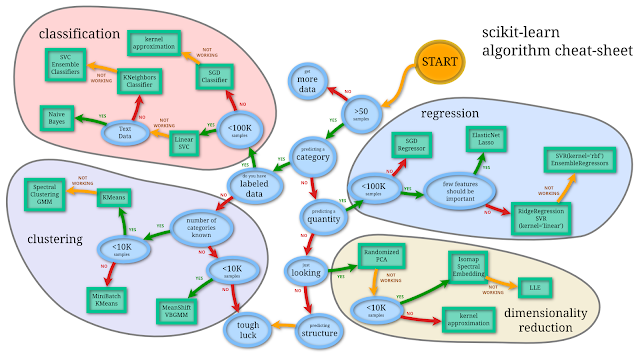
As you hopefully have heard, we at scikit-learn are doing a user survey (which is still open by the way). One of the requests there was to provide some sort of flow chart on how to do machine learning. As this is clearly impossible, I went to work straight away. This is the result: [edit2] clarification: With ensemble classifiers and ensemble regressors I mean random forests , extremely randomized trees, gradient boosted trees , and the soon-to-be-come weight boosted trees (adaboost). [/edit2] Needless to say, this sheet is completely authoritative.

Scikit-Learn 0.13 released! We want your feedback.

After a little delay, the team finished work on the 0.13 release of scikit-learn. There is also a user survey that we launched in parallel with the release, to get some feedback from our users. There is a list of changes and new features on the website . You can upgrade using easy-install or pip using: pip install -U scikit-learn or easy_install -u scikit-learn There were more than 60 people contributing to this release, with 24 people having 10 commits or more. Again many improvements are behind the scenes or only slightly notable. We improved test coverage a lot and we have much more consistent parameter names now. There is now also a user guide entry for the classification metrics, and their naming was improved. This was one of the many improvements Arnaud Joly , who joined the project very recently but nevertheless wound up being the one with the second most commits in this release! Now let me get to some of the more visible highlights of this release from my pers...

Kernel Approximations for Efficient SVMs (and other feature extraction methods) [update]

Image
Recently we added another method for kernel approximation, the Nyström method, to scikit-learn , which will be featured in the upcoming 0.13 release. Kernel-approximations were my first somewhat bigger contribution to scikit-learn and I have been thinking about them for a while. To dive into kernel approximations, first recall the kernel-trick .

Another look at MNIST

Image
I'm a bit obsessed with MNIST. Mainly because I think it should not be used in any papers any more - it is weird for a lot of reasons. When preparing the workshop we held yesterday I noticed one that I wasn't aware of yet: most of the 1-vs-1 subproblems, are really easy! Basically all pairs of numbers can be separated perfectly using a linear classifier! And even you you just do a PCA to two dimensions, they can pretty much still be linearly separated! It doesn't get much easier than that. This makes me even more sceptical about "feature learning" results on this dataset. To illustrate my point, here are all pairwise PCA projections. The image is pretty huge. Otherwise you wouldn't be able to make out individual data points. You can generate it using this very simple gist . There are some classes that are not obviously separated: 3 vs 5, 4 vs 9, 5 vs 8 and 7 vs 9. But keep in mind, this is just a PCA to two dimensions. It doesn't mean that ...

Workshop on Python, Machine Learning and Scikit-Learn

Today there was a workshop at my uni, organized by my Professor Sven Behnke, together with my colleagues Hannes Schulz, Nenard Birešev and me. The target group was a local graduate school with a general scientific background, but not much CS or machine learning. The workshop consisted of us explaining the methods and the students then playing around with them and answering some questions using IPython notebooks that we provided (if you still don't know about IPython Notebooks, watch this talk now ). Using the notebooks worked out great! There is only so much you can teach in a 5 hour workshop but I think we got across some basic concepts of machine learning and working with data in Python. We got some positive feedback and the students really went exploring. We covered PCA, k-means, linear regression, logistic regression and nearest neighbors, including some real-world examples. You can find all resources, including tex and notebooks for generating figures etc. on gith...

A Wordcloud in Python

Image
Last week I was at Pycon DE , the German Python conference. After hacking on scikit-learn a lot last week, I decided to to something different on my way back, that I had planned for quite a while: doing a wordl -like word cloud . I know, word clouds are a bit out of style but I kind of like them any way. My motivation to think about word clouds was that I thought these could be combined with topic-models to give somewhat more interesting visualizations. So I looked around to find a nice open-source implementation of word-clouds ... only to find none. (This has been a while, maybe it has changed since). While I was bored in the train last week, I came up with this code . A little today-themed taste:

Animating Random Projections of High Dimensional Data

Image
Recently Jake showed some pretty cool videos in his blog . This inspired me to go back to an idea I had some time ago, about visualizing high-dimensional data via random projections. I love to do exploratory data analysis with scikit-learn , using the manifold , decomposition and clustering module. But in the end, I can only look at two (or three) dimensions. And I really like to see what I am doing.

Recap of my first Kaggle Competition: Detecting Insults in Social Commentary [update 3]

Image
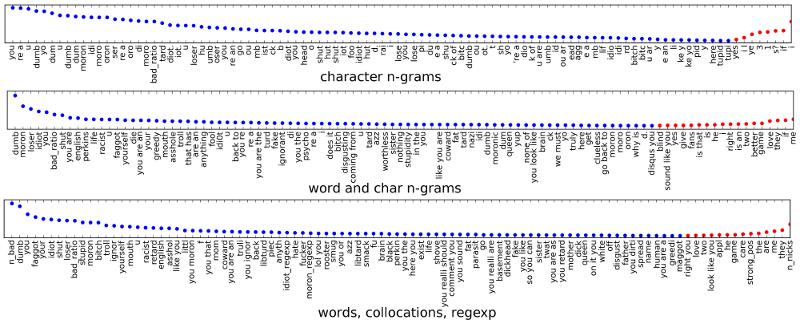
Recently I entered my first kaggle competition - for those who don't know it, it is a site running machine learning competitions. A data set and time frame is provided and the best submission gets a money prize, often something between 5000$ and 50000$. I found the approach quite interesting and could definitely use a new laptop, so I entered Detecting Insults in Social Commentary. My weapon of choice was Python with scikit-learn - for those who haven't read my blog before: I am one of the core devs of the project and never shut up about it.

Scikit-learn 0.12 released

Last night I uploaded the new version 0.12 of scikit-learn to pypi . Also the updated website is up and running and development now starts towards 0.13 . The new release has some nifty new features ( see whatsnew ): * Multidimensional scaling * Multi-Output random forests ( like these ) * Multi-task Lasso * More loss functions for ensemble methods and SGD * Better text feature extraction

Segmentation Algorithms in scikits-image

Image
Recently some segmentation and superpixel algorithms I implemented were merged into scikits-image . You can see the example here . I reimplemented Felzenszwalb's fast graph based method , quickshift and SLIC . The goal was to have easy access to some successful methods to make comparison easier and encourage experimenting with the algorithms. Here is a a comparison of my implementations against the original implementations on Lena (downscaled by a factor of 2). The first row is my implementation, the second the original.

[ECCV2012] Offset based image completion

Image
This is a short post about an ECCV 2012 paper I just discovered . The paper is Statistics of Patch Off sets for Image Completion by Kaiming He and Jian Sun from Microsoft Asia. There was a recent talk at MSRC about PatchMatch by Dan Goldman . PatchMatch is a simple but very efficient image completion algorithm that is used in Photoshop. The page linked above contains a beautiful illustration of what is possible using this very efficient, still very powerful, algorithm. For each patch that has parts that are missing, PatchMatch finds the best fit in the known image. The trick to do this fast is to use a randomized search and exploit the fact that neighboring patches have probably neighboring matches. But enough about PatchMatch - that just got me interested in this topic. So this new ECCV paper has a similar idea, but is a bit more radical. First, it looks for matching patches in the known parts of the image. It requires that these are not too close. The key observation is: th...

A filterbank for low-level vision

Image
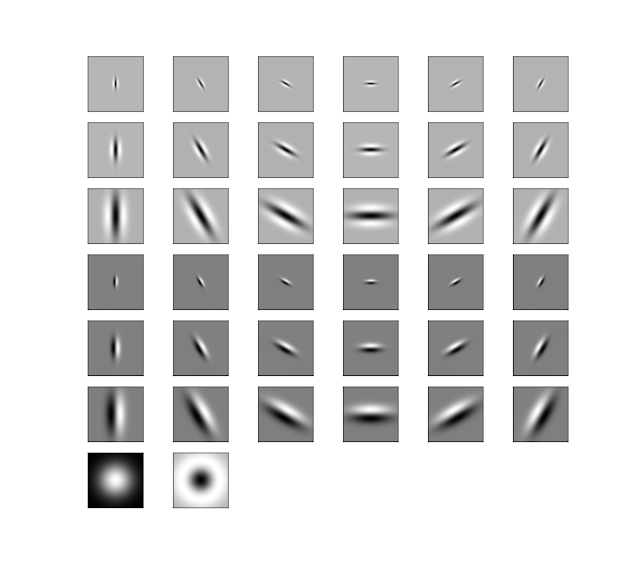
At the moment I have the pleasure to be at MSRC , working under the supervision of Carsten Rother and Sebastian Nowozin . We are tackling some low-level vision tasks (as in their recent CVPR paper ) and in this context, filter banks are very useful. They might also be useful for object detection, since one Gabor rules them all , and Google uses collections of Gabor filters for his image retrieval. I used the maximum response bank from the website of Andrew Zissermans Visual Geometry group here . My Python adaption is available as a github gist . The Root Filter set looks like this:

Update for structured SVM in Python

I just pushed an update for my structured SVM in Python. This contains a bugfix in the dual formulation  and a subgradient descent version of the structured SVM.

Structured SVM and Structured Perceptron for CRF learning in Python

Image
[EDIT: If you are reading this now, have a look at pystruct.github.io . The project matured quit a bit in the meantime.]  Today I pushed some of my code to github that I use for experimenting with CRF learning. This goes along the lines of my recent posts on graphcut and I hope to post a full CRF learning framework for semantic image segmentation soon. This is a pretty standard setup in computer vision, but I really haven't found much code online. Actually I haven't found any code to learn loopy CRFs, so I hope my simple implementation can help to get a better understanding of these methods. It certainly helped me ;)