Posts

pystruct: more structured prediction with python

Image
Some time ago I wrote about a structured learning project I have been working on for some time, called pystruct . After not working on it for some time, I think it has come quite a long way the last couple of weeks as I picked up work on structured SVMs again. So here is a quick update on what you can do with it. To the best of my knowledge this is the only tool with ready-to-use functionality to learn structural SVMs (or max-margin CRFs) on loopy graphs - even though this is pretty standard in the (computer vision) literature.
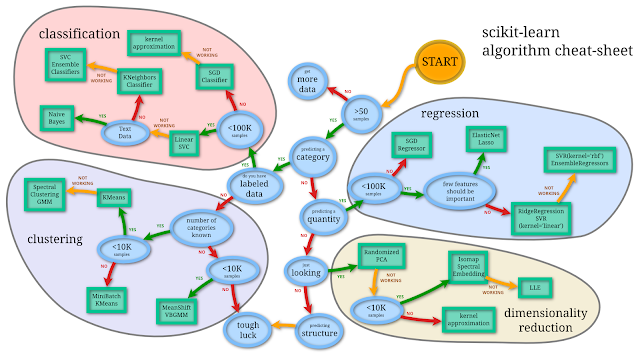
Machine Learning Cheat Sheet (for scikit-learn)

Image
As you hopefully have heard, we at scikit-learn are doing a user survey (which is still open by the way). One of the requests there was to provide some sort of flow chart on how to do machine learning. As this is clearly impossible, I went to work straight away. This is the result: [edit2] clarification: With ensemble classifiers and ensemble regressors I mean random forests , extremely randomized trees, gradient boosted trees , and the soon-to-be-come weight boosted trees (adaboost). [/edit2] Needless to say, this sheet is completely authoritative.

Scikit-Learn 0.13 released! We want your feedback.

After a little delay, the team finished work on the 0.13 release of scikit-learn. There is also a user survey that we launched in parallel with the release, to get some feedback from our users. There is a list of changes and new features on the website . You can upgrade using easy-install or pip using: pip install -U scikit-learn or easy_install -u scikit-learn There were more than 60 people contributing to this release, with 24 people having 10 commits or more. Again many improvements are behind the scenes or only slightly notable. We improved test coverage a lot and we have much more consistent parameter names now. There is now also a user guide entry for the classification metrics, and their naming was improved. This was one of the many improvements Arnaud Joly , who joined the project very recently but nevertheless wound up being the one with the second most commits in this release! Now let me get to some of the more visible highlights of this release from my pers...

Kernel Approximations for Efficient SVMs (and other feature extraction methods) [update]

Image
Recently we added another method for kernel approximation, the Nyström method, to scikit-learn , which will be featured in the upcoming 0.13 release. Kernel-approximations were my first somewhat bigger contribution to scikit-learn and I have been thinking about them for a while. To dive into kernel approximations, first recall the kernel-trick .

Another look at MNIST

Image
I'm a bit obsessed with MNIST. Mainly because I think it should not be used in any papers any more - it is weird for a lot of reasons. When preparing the workshop we held yesterday I noticed one that I wasn't aware of yet: most of the 1-vs-1 subproblems, are really easy! Basically all pairs of numbers can be separated perfectly using a linear classifier! And even you you just do a PCA to two dimensions, they can pretty much still be linearly separated! It doesn't get much easier than that. This makes me even more sceptical about "feature learning" results on this dataset. To illustrate my point, here are all pairwise PCA projections. The image is pretty huge. Otherwise you wouldn't be able to make out individual data points. You can generate it using this very simple gist . There are some classes that are not obviously separated: 3 vs 5, 4 vs 9, 5 vs 8 and 7 vs 9. But keep in mind, this is just a PCA to two dimensions. It doesn't mean that ...

Workshop on Python, Machine Learning and Scikit-Learn

Today there was a workshop at my uni, organized by my Professor Sven Behnke, together with my colleagues Hannes Schulz, Nenard Birešev and me. The target group was a local graduate school with a general scientific background, but not much CS or machine learning. The workshop consisted of us explaining the methods and the students then playing around with them and answering some questions using IPython notebooks that we provided (if you still don't know about IPython Notebooks, watch this talk now ). Using the notebooks worked out great! There is only so much you can teach in a 5 hour workshop but I think we got across some basic concepts of machine learning and working with data in Python. We got some positive feedback and the students really went exploring. We covered PCA, k-means, linear regression, logistic regression and nearest neighbors, including some real-world examples. You can find all resources, including tex and notebooks for generating figures etc. on gith...

A Wordcloud in Python

Image
Last week I was at Pycon DE , the German Python conference. After hacking on scikit-learn a lot last week, I decided to to something different on my way back, that I had planned for quite a while: doing a wordl -like word cloud . I know, word clouds are a bit out of style but I kind of like them any way. My motivation to think about word clouds was that I thought these could be combined with topic-models to give somewhat more interesting visualizations. So I looked around to find a nice open-source implementation of word-clouds ... only to find none. (This has been a while, maybe it has changed since). While I was bored in the train last week, I came up with this code . A little today-themed taste: